Einstein Telescope – KEYES Contributes to Designing the Data Centers of the Future

On 7 July 2026, the European research project SCOPE officially entered its implementation phase with the launch of prototype construction. A true innovation laboratory, this technology demonstrator will enable the testing of technologies that could power the future digital infrastructure of the Einstein Telescope.
As a selected member of the European consortium, KEYES will leverage nearly forty years of expertise in critical digital infrastructure to design the prototype's IT infrastructure and help develop technologies that will benefit both the Einstein Telescope and, more broadly, the next generation of Data Centers.
The Einstein Telescope is one of the most ambitious scientific projects currently under development in Europe. This next-generation underground observatory will detect gravitational waves with unprecedented precision, helping scientists better understand the origin and evolution of the Universe.
Three European regions are currently competing to host this exceptional scientific infrastructure: the Meuse-Rhine Euregio (Belgium – the Netherlands – Germany), Sardinia, and Saxony.
To support this candidacy process, several European research projects have been launched to develop the technologies that could underpin these future scientific infrastructures. SCOPE (Sustainable Computing Prototype for Einstein Telescope) is one of these initiatives, and KEYES is among the European partners selected to contribute to this ambitious project.
SCOPE aims to design and test a new model of Data Center capable of addressing a major challenge: reconciling the growing computational demands of high-performance scientific computing with the need for energy efficiency and long-term sustainability.
As a unique experimental platform, the project will pave the way for a new generation of Data Centers that are more energy-efficient, more intelligent and more resilient, supporting the digital society of tomorrow.
KEYES Envisions the Data Center of the Future
The Einstein Telescope will generate vast volumes of scientific data. Processing this information continuously will require infrastructures capable of handling massive data flows through high-performance computing (HPC), artificial intelligence and emerging computing architectures such as quantum technologies.
Against this backdrop, KEYES has joined a consortium of ten European partners to design the prototype's IT infrastructure. KEYES teams will contribute their expertise in Data Centers, high-performance computing, networking, virtualization, cybersecurity and critical infrastructure, working alongside the Universities of Aachen, Maastricht and Liège.
Marc Delincé, Senior Advisor and SCOPE Project Manager at KEYES
"SCOPE is a true innovation laboratory. It gives us a unique opportunity to experiment with technologies that simply could not be tested in a conventional production environment.
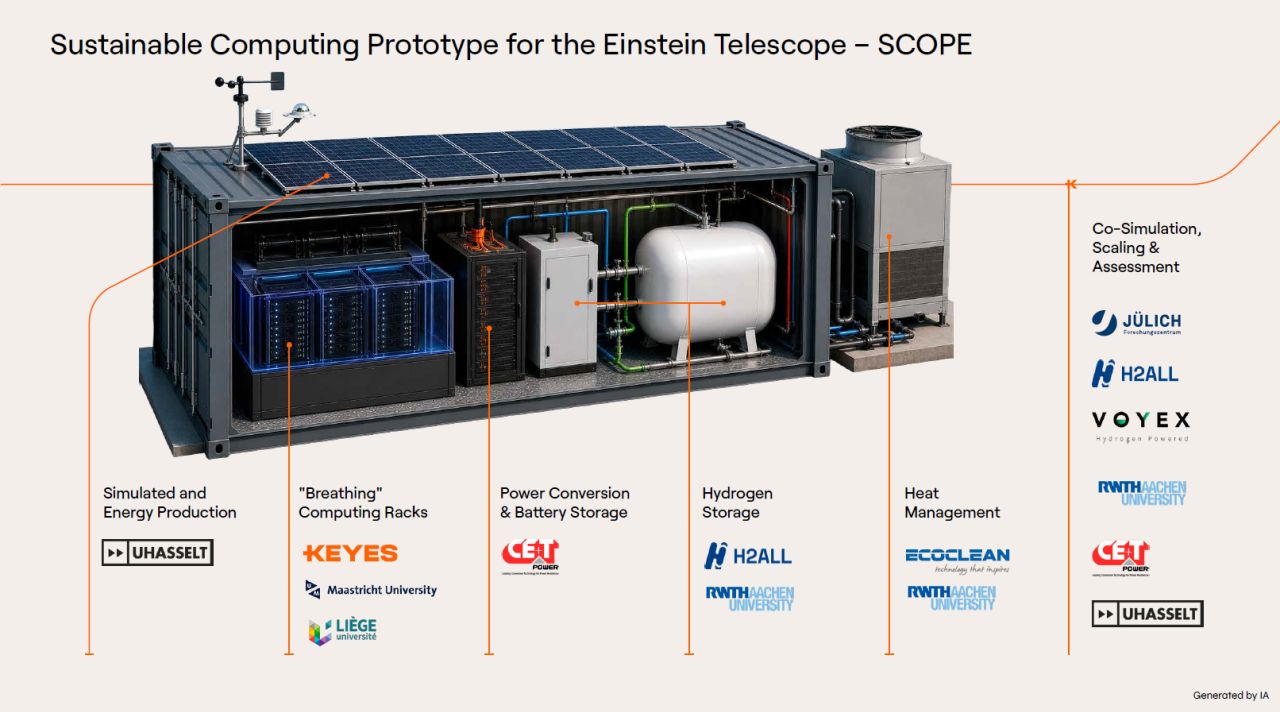
Housed inside a shipping container, the prototype will combine a high-performance computing (HPC) infrastructure, battery and hydrogen energy storage systems, and several innovative cooling technologies.
One of the project's key innovations is an approach known as breathing computing. Unlike traditional infrastructures, where computing systems operate independently of energy constraints, the prototype will dynamically adapt computing workloads to the availability of renewable energy sources and storage capacity.
This approach will simultaneously optimize computing performance, energy consumption and CO₂ emissions."
At a time when artificial intelligence, digital sovereignty and the energy transition are profoundly reshaping organizations' needs, investing in research and innovation is a strategic choice.
Laurence Mathieu, CEO of KEYES
"At KEYES, we believe that innovation is not just about inventing entirely new technologies. Innovation is also about combining existing technologies in new ways, bringing complementary areas of expertise together, and uniting the right talent around a shared ambition to create greater value.
SCOPE is a perfect illustration of this vision. By combining our expertise in critical infrastructure, cybersecurity, artificial intelligence, Data Centers and the management of sensitive data with the knowledge of our academic and industrial partners, we are helping develop high-value solutions with long-term impact.
For nearly forty years, KEYES has played this role as a catalyst within Belgium's digital ecosystem. We believe in innovation that is pragmatic, open and purposeful—innovation that transforms collective excellence into concrete solutions addressing society's most pressing challenges.
Being involved in a scientific project of this magnitude is tremendous recognition of our teams' expertise. It also confirms that bringing together the best expertise is now one of the key drivers of European innovation."
A Regional and European Innovation Ecosystem
The SCOPE project represents a total investment of more than €5.2 million, funded through the Interreg Meuse-Rhine Euregio programme, and brings together ten scientific, academic and industrial partners from Belgium, Germany and the Netherlands.
Beyond this European collaboration, SCOPE forms part of a broader regional mobilisation supporting the Meuse-Rhine Euregio's bid to host the Einstein Telescope. In Wallonia, this initiative brings together key institutional stakeholders, including GRE-Liège, Wallonie Entreprendre, Logistics in Wallonia, GreenWin, Skywin, MecaTech Cluster, the Walloon Public Service (SPW) and Wallonia-Brussels International.
This cooperation reflects a shared ambition to strengthen the Meuse-Rhine Euregio's position as a leading European hub for research, innovation and advanced technologies.
Project Milestones
- May 2026: Consortium selected.
- 7 July 2026: Development of the SCOPE prototype officially begins at the Jülich site in Germany.
- Late 2027: The European Union will select the host region for the Einstein Telescope from the three competing bids: the Meuse-Rhine Euregio, Sardinia and Saxony.
- From 2028 onwards: Launch of procurement procedures for the various components of the infrastructure, including the IT infrastructure.
- 2035: Planned commissioning of the Einstein Telescope, with an expected operational lifetime of approximately fifty years.
SCOPE Project Partners